



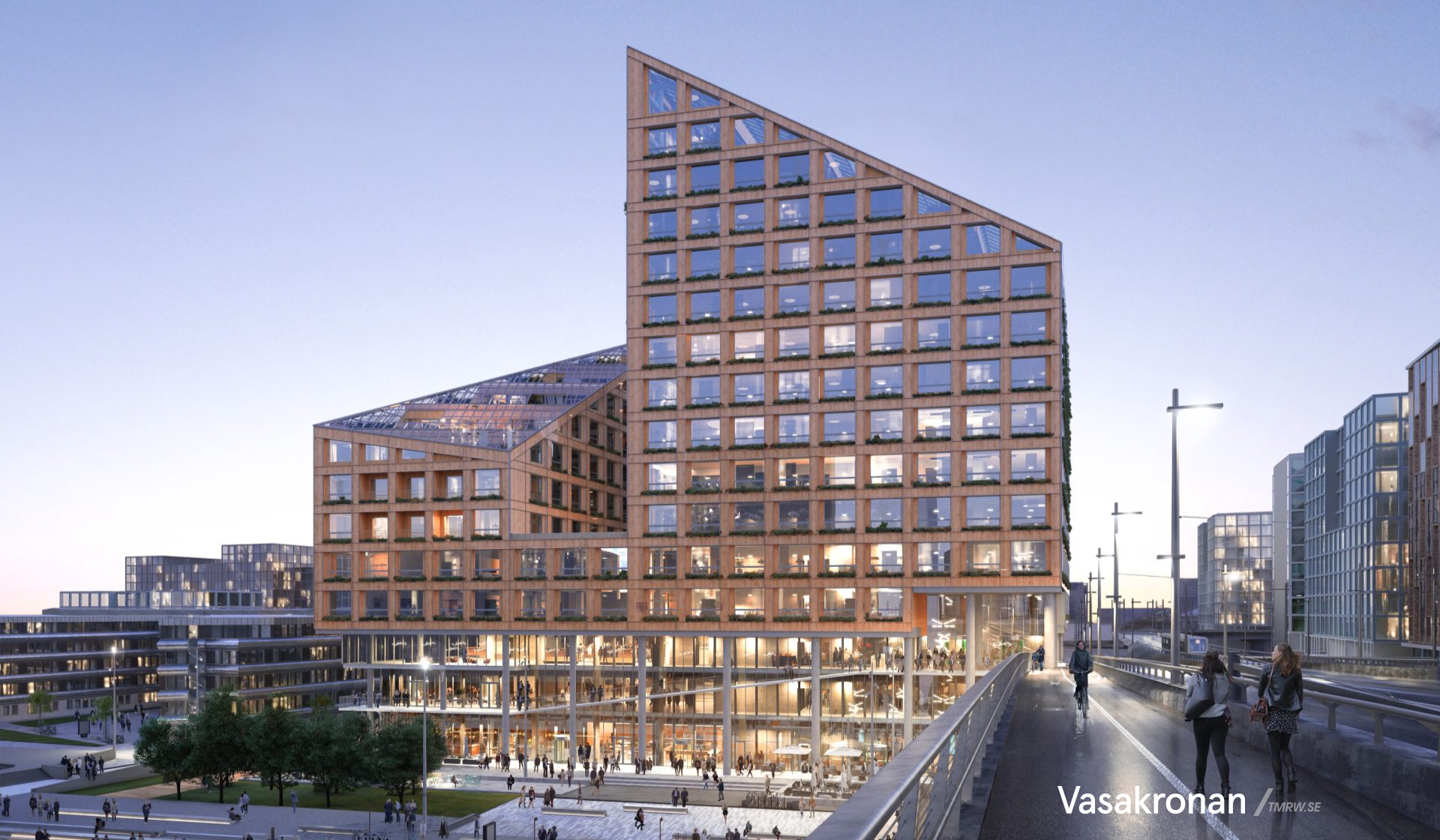
Vasakronan continues to develop Lilla Bommen, and since 2023, Akuro, commissioned by Mark- och Energibyggarna, has been managing the design for the foundation phase and basement in the construction of Kaj 16.
Kaj 16 is Vasakronan's second new construction project focusing on timber construction, with 12 of its 17 floors made of timber. Centrally located on the quayside by the Göta River, the building spans 30,000 sqm and forms an important part of Gothenburg's major urban development project Älvstaden.
The project as a whole has been procured as a split contract, and the foundation phase, including the basement, is being carried out as a turnkey contract in collaboration between Vasakronan and Mark- och Energibyggarna. The foundation work is now in full production, while the design of the building structure is in the system and construction document phase.
Akuro's Ina Tofalvi holds the role of assistant design manager with a focus and specialist expertise in digitalization. Ina is involved in developing new routines and working methods and continuously trains the project team. Kaj 16 has high ambitions and very high goals in both sustainability and digitalization.
"Our role in this project is to manage the project digitally and contribute innovative solutions to advance the construction industry. Together with the client Vasakronan, we dare to push boundaries and adopt new working methods. Akuro wants to be part of creating a more efficient and sustainable construction process; we are convinced that digitalization is the key." says Ina Tofalvi.
One of the most remarkable design and production aspects of Kaj 16 is the decision to take digitalization to the next level by completely eliminating drawings and relying solely on the 3D model as the legal document. This step towards increased digitalization reflects a broader industry trend and goes hand in hand with Akuro's commitment to innovation.
“By executing a construction project entirely model-based, with BIM as the working method and delivery approach, a more efficient and sustainable construction process is enabled. When non-interactive tools like PDF drawings are eliminated and the model is used as a working tool in production, significant opportunities arise to reduce risks of errors and increase efficiency.” - explains Ina
The project has chosen to work with StreamBIM, a platform that enables model-based design and production. The project team can meticulously manage everything from quantity take-offs and material procurement to tracking the building's progress in real-time. For instance, the model has been used to perform advanced simulations and determine production methods for mass displacement, which has reduced the risk of impact on nearby structures. Given the project's high environmental profile, there is a strong focus on reuse, even in the foundation phase. Existing piles are being reused, as is crushed concrete in the form of aggregate, which comes from the demolished Kromet building that previously stood on the site.
Kaj 16 is an opportunity for us to collectively develop and grow within an increasingly digitalized construction industry. Our role extends beyond the technical – we also act as change leaders, ensuring that all involved parties work towards the same goals and possess the necessary digital competence. A project should not be dependent on a single BIM coordinator.
“To use BIM as effectively as possible, it's crucial to provide training, both in increased technical competence and, more importantly, in understanding its purpose and benefits. Only when the entire organization is on board and has the right foundational knowledge will 3D models be able to be utilized to their full potential.” - Ina continues
Kaj 16 is one of the projects where we are implementing digitized workflows. The project exemplifies Akuro's ambition to be at the forefront of digital innovation.